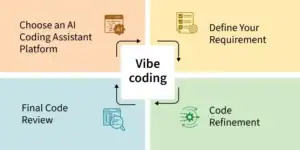
Vibe coding—the practice of building software using AI-powered prompts instead of manually writing syntax—has quickly made its way into classrooms, coding bootcamps, and student projects. For educators, this shift poses both an exciting opportunity and a difficult challenge. On one hand, vibe coding lowers barriers to entry and makes coding feel more accessible. On the other, it risks leaving learners without the deep understanding of syntax, logic, and structure they still need to thrive as developers.
So, how exactly does vibe coding work in educational settings? What benefits does it offer to students and bootcamps? And where does it fall short? Let’s dive in.
Why Vibe Coding Matters in Education
Making Coding More Accessible
For many students, especially beginners, the steepest barrier in programming is syntax. Missing a semicolon, misusing indentation, or forgetting an import can derail motivation. Vibe coding allows them to skip those early frustrations and focus on problem-solving.
Bootcamps and schools are realizing this: if students can prototype faster, they gain confidence and see the immediate impact of coding, which keeps them engaged.
Democratizing Entry Into Tech
Not every learner wants to become a professional software engineer. Some want to build apps for side projects, automate workflows, or create domain-specific solutions. Vibe coding gives them the power to do so without spending years learning traditional coding languages.
What Works in Student and Bootcamp Environments
Rapid Prototyping and Creativity
Students can go from idea to working prototype in hours instead of weeks. For example:
- A student can design a study planner app by simply prompting an AI tool.
- Bootcamp cohorts can hack together MVPs during project weeks without drowning in boilerplate code.
This accelerates creativity and experimentation, a crucial part of learning.
Focus on Problem-Solving, Not Just Syntax
Vibe coding allows learners to spend more time on:
- Understanding algorithms.
- Mapping user needs to software functionality.
- Designing intuitive user experiences.
This approach reflects how real-world software development works: tools evolve, but problem-solving is always at the core.
Lowering Dropout Rates
Bootcamps often struggle with retention, especially among students intimidated by code. By making early wins possible, vibe coding boosts motivation. Learners see results sooner, which keeps them on track.
Where Vibe Coding Breaks Down in Education
Weakening of Fundamentals
The biggest risk is that students skip learning the underlying logic and syntax of programming. Without understanding loops, conditionals, or debugging, they may become over-dependent on AI and unable to handle real-world complexity.
Black-Box Learning
AI-generated code can work, but students often don’t know why it works. When asked to explain a solution or modify it in detail, they may be lost. Bootcamps risk producing “AI operators” instead of true developers.
Debugging Gaps
Debugging is a skill that only comes with practice. In vibe coding, when something goes wrong, many students simply re-prompt the AI rather than learning how to diagnose the issue themselves. This creates fragile problem-solvers.
Over-Reliance on Tool Ecosystems
Bootcamps that tie themselves too closely to a single vibe coding platform risk locking students into workflows that don’t generalize. If a company uses different AI tools—or none at all—graduates may struggle to adapt.
How Bootcamps and Schools Are Responding
Blended Learning Models
The most promising approach is blending vibe coding with traditional coding practice. For example:
- Use vibe coding to scaffold projects quickly.
- Then require students to break down AI-generated code and rewrite core components manually.
- Alternate between “AI-assisted” and “from-scratch” coding challenges.
Teaching Prompt Engineering as a Skill
Some bootcamps now teach prompt design alongside Python or JavaScript. Students learn how to guide AI tools with specificity, provide context across multiple repos, and refine outputs. This hybrid skillset is increasingly valuable in industry.
Emphasizing Review and Refactoring
Instead of measuring success purely by output, educators can focus on code review. Students are graded not just on working software, but also on their ability to explain, critique, and refactor AI-generated code.
What This Means for Students
The Benefits
- Faster learning curve: Get from zero to working prototype quickly.
- Confidence building: Early wins increase motivation.
- Relevance: Gain experience with tools already entering the job market.
The Risks
- Shallow knowledge: Risk of skipping fundamentals.
- Limited adaptability: Without deep skills, harder to pivot across tools or contexts.
- Career ceiling: Entry-level roles may demand more than “vibe coding fluency.”
Students who want careers as professional developers need to treat vibe coding as a supplement, not a replacement for fundamentals.
What This Means for Bootcamps
A Differentiator in Marketing
Bootcamps that integrate vibe coding can position themselves as forward-thinking and aligned with industry trends. “Learn AI-assisted development” is an attractive pitch.
A Challenge for Curriculum Design
However, this requires careful balance. Lean too heavily on AI, and graduates may lack resilience. Ignore it entirely, and the bootcamp risks irrelevance.
Preparing Students for Real Jobs
Employers want hires who can use AI tools but also understand architecture, testing, and debugging. Bootcamps need to prepare graduates for this hybrid expectation.
The Future of Vibe Coding in Education
Likely Evolution in the Next 1–2 Years
- Hybrid classes: Mixing theory, syntax, and vibe coding workflows.
- Dedicated vibe coding modules: Teaching prompt engineering, context management, and debugging AI output.
- Employer partnerships: Bootcamps collaborating with companies to align vibe coding training with real job requirements.
From Learning to Lifelong Skills
Students must recognize that vibe coding tools will evolve. The transferable skills are:
- Clear communication with AI systems.
- Ability to critique and improve AI output.
- Deep understanding of core programming principles.
Conclusion: Education Needs Balance
Vibe coding is reshaping how students and bootcamps approach programming. It works brilliantly for accessibility, motivation, and rapid prototyping. But it breaks down when learners treat it as a shortcut that replaces fundamentals.
The best path forward? Balance.
- Students should use vibe coding to accelerate learning, but also commit to mastering syntax, debugging, and design.
- Bootcamps should integrate AI workflows while still emphasizing problem-solving and review.
- Developers of tomorrow must be both AI collaborators and grounded engineers.
If educational settings strike this balance, vibe coding won’t just be a fad—it will become a powerful tool for creating the next generation of adaptable, creative, and AI-empowered developers.