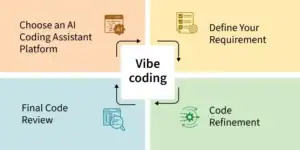
The rise of vibe coding—building software through prompts, context, and AI-assisted workflows instead of traditional syntax-heavy development—is shaking up not just how apps get built, but also how companies think about hiring, skills, and the future of work.
For developers, students, and even non-technical professionals, the question is urgent: Are companies really looking for vibe coding skills? What do they expect from candidates? And what does this mean for the future of jobs in tech?
This post dives deep into the impact of vibe coding on job markets, what hiring managers are thinking, and what skills will remain indispensable as AI-driven workflows expand.
Why Vibe Coding Is Entering the Hiring Conversation
From Experimentation to Adoption
Just two years ago, vibe coding was seen as a curiosity—a faster way for hobbyists and indie makers to launch prototypes. Today, AI-assisted development tools like Cursor, Windsurf, Claude, Qoder.AI, and Copilot are being piloted in major companies.
This shift is happening for three reasons:
- Efficiency gains – Projects that took weeks now take days.
- Lower costs – Fewer engineers can handle more workload with AI.
- Talent expansion – Non-traditional candidates can now contribute meaningfully.
Why Employers Care
Companies don’t want just “coders” anymore—they want AI-empowered problem solvers. Vibe coding represents an evolution of what it means to be productive in tech. If you can build reliable features quickly using AI, you’re valuable—even without a CS degree.
Are Companies Actively Looking for Vibe Coding Skills?
The Early Signals
While “vibe coding” itself might not yet appear in job listings, the underlying expectations are emerging:
- Familiarity with AI development tools (Cursor, Copilot, Windsurf).
- Ability to write clear prompts and manage context.
- Comfort with AI-assisted debugging and refactoring.
- Understanding of where AI fits and where it breaks down.
Case Studies in Hiring
- Startups: Increasingly ask candidates how they’ve used AI to accelerate development. Many expect portfolio projects demonstrating AI-assisted builds.
- Bootcamps: Some now include vibe coding in their curricula, reflecting employer demand.
- Enterprises: At larger firms, “AI literacy” is becoming as important as cloud or DevOps knowledge.
What Recruiters Say
Recruiters report that companies are not replacing traditional developers outright. Instead, they prefer hybrid candidates—those who can leverage vibe coding while still understanding fundamentals like architecture, testing, and scalability.
What Companies Expect From Vibe Coding Developers
1. Strong Prompting and Context Management Skills
Companies want developers who can:
- Frame clear, detailed prompts.
- Manage multi-repo or multi-service context effectively.
- Iterate efficiently when AI outputs need correction.
This skill is less about typing code and more about communicating intent clearly to AI.
2. Critical Thinking, Not Blind Trust
AI can generate impressive but flawed solutions. Employers expect candidates to:
- Spot errors or inefficiencies.
- Debug and refactor AI outputs.
- Know when to reject or rewrite AI-generated code.
3. Blending AI with Traditional Development
Vibe coding is not a replacement for fundamentals. Companies still want:
- Knowledge of system design.
- Understanding of databases, APIs, and integrations.
- Skills in version control and CI/CD.
The expectation: developers who can use AI as an accelerator, not a crutch.
4. Collaboration and Documentation
AI helps generate code, but humans must collaborate, review, and maintain it. Employers expect vibe coding professionals to:
- Document AI-driven workflows.
- Explain code to teammates.
- Contribute to long-term maintainability.
What This Means for Developers
The Opportunities
For developers who embrace vibe coding:
- Faster portfolios – You can showcase projects built in weeks, not months.
- Lower entry barriers – Non-traditional candidates (students, moms, career changers) can join the tech workforce.
- Hybrid job roles – Product managers, designers, and analysts can now build functional apps using vibe coding.
In short: vibe coding makes tech careers more accessible.
The Risks
But there are risks if developers rely solely on vibe coding:
- Shallow skills – Without fundamentals, your ceiling is limited.
- Over-dependence – If AI fails, you may not know how to recover.
- Competitive pressure – Developers who combine fundamentals + vibe coding will always outpace those who only know one side.
How Vibe Coding Changes Hiring Processes
Technical Assessments
Expect to see interviews evolve. Instead of asking candidates to write algorithms from scratch, companies may test:
- How you prompt AI to generate a function.
- How you debug AI’s output.
- How you explain trade-offs between AI-generated vs. hand-written code.
Portfolios Over Degrees
Employers increasingly value what you’ve built over formal qualifications. A vibe coding portfolio with working apps can sometimes outshine a degree.
New Job Titles
We may see emerging roles like:
- AI Development Specialist
- Prompt Engineer for Code
- AI Workflow Architect
These roles reflect vibe coding’s growing influence in the hiring landscape.
What Developers Should Do to Stay Relevant
1. Learn Prompt Engineering
Mastering the art of giving AI clear, structured instructions is becoming as essential as learning a new programming language.
2. Double Down on Fundamentals
AI can’t replace knowledge of:
- Algorithms
- Data structures
- System architecture
- Debugging
Think of vibe coding as the “calculator”—but you still need to understand the math.
3. Build Real Projects
Employers want proof. Create:
- Automations (e.g., AI + Google Sheets).
- Simple web apps.
- Chatbots, image generators, or summarizers.
Show you can turn prompts into production-ready outcomes.
4. Stay Adaptable
The vibe coding ecosystem is evolving quickly. Tools like Cursor and Claude may dominate today, but new platforms will emerge. Focus on skills that transfer across tools: clarity, structure, problem-solving.
The Broader Impact on Job Markets
More Non-Traditional Entrants
Moms at home, students, and career changers can now access tech jobs faster. This expands the overall talent pool.
Pressure on Traditional Developers
Junior developers may face stiffer competition. Employers may prefer AI-empowered candidates over those who only bring syntax skills.
New Kinds of Teams
Expect to see leaner dev teams, where fewer engineers manage larger workloads with AI support. Developers may collaborate more with product managers and business roles who use vibe coding to contribute directly.
The Next 1–2 Years
Short-Term
- More companies experimenting with vibe coding tools.
- Recruiters asking candidates about AI-assisted workflows.
- Bootcamps and universities adding vibe coding modules.
Long-Term
- Formal job descriptions requiring “AI development experience.”
- Clearer career paths for hybrid roles (AI + coding).
- Employers balancing speed from AI with resilience from fundamentals.
Conclusion: Developers Need to Evolve, Not Panic
Vibe coding is not a threat—it’s a shift. Companies are beginning to expect developers to be fluent in AI-accelerated development, but they also want the same timeless skills: problem-solving, architecture, collaboration, and critical thinking.
For developers, the key takeaway is this: don’t rely on vibe coding alone. Instead, treat it as a force multiplier. Combine it with your fundamentals, build strong portfolios, and position yourself as a professional who can blend the power of AI with the depth of engineering expertise.
That’s the profile companies are already starting to look for—and the one that will thrive as the job market adapts to vibe coding.